Case Study
Securing the SOC in the AI age
)
Security operations centers are under pressure from every direction.
Alert volumes are rising. Adversary breakout times are shrinking. Ransomware now accounts for nearly half of all breaches, per the 2026 Verizon Data Breach Investigations Report.
And the analysts responsible for triaging threats faster are spending more than a quarter of their time on alerts that turn out to be noise.
AI is beginning to reshape how SOCs operate—accelerating vulnerability prioritization, automating initial triage, and giving teams faster, more evidence-based decisions inside a narrowing response window. But AI also introduces new exposure: autonomous agents need secure pathways, SOC tooling becomes a target, and the attack surface can expand as quickly as the technology intended to shrink it.
Xiid’s Terniion platform provides SOC and MSSP teams with a different kind of foundation. Not another detection layer, but a deterministic security architecture that uses our patented SealedTunnel technology to remove infrastructure from the attack surface, pre-position access for rapid response, and enable instant isolation without losing the visibility that makes investigation possible.
Industry Challenge: The Modern SOC Under Pressure
Across commercial, government, and managed security environments, SOC and MSSP teams face a common set of escalating pressures:
Alert volume outpaces capacity. The average SOC receives nearly 3,000 security alerts per day. Nearly half are false positives. Analysts spend more than 25% of their time on noise before they reach the threats that matter.
Adversaries move faster than response cycles. Attackers now achieve lateral movement in an average of 62 minutes from initial compromise (CrowdStrike 2025 Global Threat Report). When the triage window and the breakout window overlap, investigation time becomes a liability.
Vulnerability backlogs are growing. The 2026 Verizon DBIR reports that only 26% of known exploited vulnerabilities were fully remediated in 2025. The median time to patch a critical vulnerability rose to 43 days. Unpatched systems are runways, not risks.
Third-party exposure is accelerating. Third-party involvement now appears in 48% of breaches — up 60% in a single year. For MSSPs managing multi-tenant environments, this scenario creates both client risk and cross-tenant exposure.
SOC tooling itself is a target. SIEM, SOAR, log aggregation, and compliance platforms hold the most sensitive telemetry in an organization. If an adversary compromises the tools used to detect them, they break the chain of custody.
The Xiid Solution: Deterministic Security for the Autonomous SOC
Terniion does not replace the SOC stack. It secures the foundation beneath it to make infrastructure non-addressable, pre-positions CSIRT access before incidents occur, and enables instant isolation without losing control. Three scenarios define where Terniion changes the outcome for SOC and MSSP teams.
Pre-Position Access Before the Alarm Sounds
Detection isn’t the most common SOC failure. It’s actually the time lost between detection and action, before
A tunnel is provisioned
Access is approved
An analyst can reach the affected system
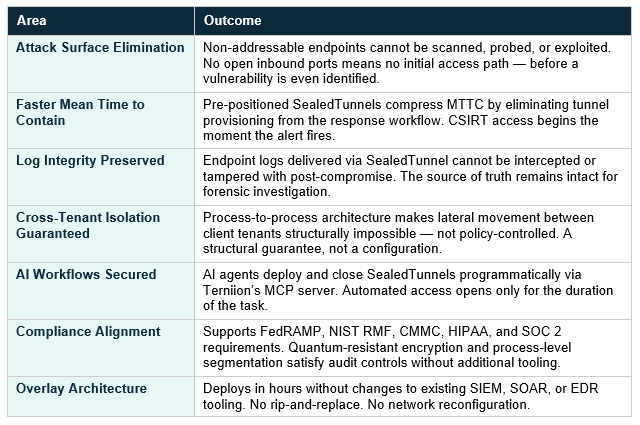
Terniion’s SealedTunnels can be deployed proactively across managed endpoints long before any incident occurs. When a SIEM fires an alert, the secure channel is already in place. The analyst is already in. There is nothing left to provision under pressure.
Pre-positioned SealedTunnels also protect the integrity of log delivery. All endpoint logs route to the SIEM through outbound-only, tamper-resistant channels. Even if an endpoint is compromised, the logs it sends cannot be intercepted or altered. When logs are tampered with, the source of truth is gone. Terniion preserves it.
2. Isolate Instantly, Without Losing Access
Whether by an AI triage agent or a human analyst, the speed of threat containment determines whether an incident stays contained or becomes a breach. The 2026 DBIR confirms that vendor pathways now appear in nearly half of all breaches. For MSSPs, lateral movement across client environments isn’t just a theoretical risk. It’s the specific exposure clients pay to prevent.
Terniion enables instant, policy-driven isolation of any endpoint or workload. The affected system is removed from the network in less than a second. But the CSIRT tunnel remains intact. The analyst can still reach the isolated system, investigate, and remediate without re-exposing the environment.
Cross-tenant lateral movement is architecturally impossible. Terniion’s process-to-process tunnels are structurally guaranteed to create dedicated, isolated communication paths per tenant. There is no shared network layer for an adversary to traverse.
3. AI-Assisted Vulnerability Triage at Scale
Modern enterprise and government environments generate more vulnerabilities than any team can manually prioritize. A single scan across a large organization can surface thousands of findings across tens of thousands of endpoints. Analysts triage the worst ones, patch what they can, and accept risk on the rest.
AI changes this calculus, but only if the AI agent has secure, controlled pathways to the systems it needs to reach. Terniion’s MCP server enables AI-driven SOC agents to programmatically deploy SealedTunnels to vulnerable endpoints, execute audits or remediations, and close access when the task is complete, all without opening inbound ports or expanding the attack surface.
For managed services providers building AI-assisted compliance and vulnerability management workflows, this means AI acts faster, within a tighter security boundary, than any human-driven process could sustain.
In Practice: A Government-Focused Managed Services Provider
A government-focused managed services provider that runs SOC operations for public sector clients is building a new AI-assisted service based on the NIST Risk Management Framework (RMF). The goal is to automate the assessment process, which typically requires weeks of manual effort, surface actionable vulnerability intelligence, and give clients real insight into their security posture instead of checkbox compliance that passes on paper while leaving real exposure unaddressed.
Terniion is embedded at two stages in this workflow.
Stage 1: AI-Driven Assessment
Xiid’s MCP server gives the AI assessment agent programmatic access to spin up SealedTunnels to endpoints across client environments, run compliance checks, and return findings to the central platform without opening inbound ports on client infrastructure or requiring permanent network-level access. When the task completes, the tunnel closes. The client environment returns to its non-addressable state.
Stage 2: Incident Response
When a high-priority finding is identified, or when a SIEM alert triggers an incident response workflow, pre-positioned SealedTunnels give CSIRT analysts immediate access to the affected endpoint. The system is isolated from the rest of the client environment. The investigation proceeds. The rest of the tenant’s environment is unaffected by design, not by policy.
As this provider expands the service to its public sector client base, Terniion will be embedded as the secure connectivity layer for every assessment and every incident response engagement. The same architecture that protects the provider’s own operations becomes the foundation of the service it sells.
Business Impact and ROI
Proven Reliability
Terniion carries an unconditional Authority to Operate from the U.S. Department of Defense. This designation has not been awarded to any other cybersecurity vendor. What’s more, the U.S. Air Force Research Laboratory conducted independent penetration testing in 2024 and declared the infrastructure effectively unreachable to standard attack methodologies.
Terniion is currently protecting workloads for the Defense Health Agency, CI/CD pipelines for defense contractors, and sensitive data flows across federal agencies, as well as enterprise use within AI tools and EV charging stations. The platform scales from single endpoints to enterprise environments with tens of thousands of managed assets, with SealedTunnels deployable in under 90 seconds and manageable from a single control plane.
Conclusion
The SOC is losing ground because their tools' underlying infrastructure was not designed for the threat model they now face. AI will accelerate both attack and defense, but the teams that benefit most from AI-driven operations are the ones that built on a foundation that does not depend on people or policies to keep adversaries out.
Terniion removes infrastructure from the attack surface before the first alert fires. It pre-positions access so response starts in seconds. And when containment happens, it does so without losing the visibility that makes investigation possible.
Related content
)
Autonomous Attack Paths: The Security Problem AI Is Creating
As organizations deploy AI agents, autonomous workflows, copilots, and machine-driven orchestration platforms, the actions that matter are no longer primarily human-initiated.
Read Blog)
Terniion redefines enterprise cybersecurity defense | Xiid
This white paper details Xiid’s approach, demonstrating how preemptive methods outpace and outlast yesterday’s detection-and-response standards, delivering enterprise security that is secure by design and unreachable for attackers.
Read White Paper)
Terniion for AI infrastructure | Xiid
Terniion eliminates the attack surface across the AI lifecycle—from data collection through training, inference, and agent-to-agent communication—without rewriting pipelines or replacing infrastructure.
Read Data Sheet