Blog
Tailscale vs Terniion: Speed, security, and the control plane question
)
Key takeaways
Tailscale and Terniion both skip legacy VPN hardware, but they trust different things. Tailscale trusts the device. Terniion trusts the process, and only for the moment it needs access.
A compromised device keeps its place on Tailscale's tailnet until an admin manually revokes it. A compromised Terniion session has nothing left to compromise once its task ends.
On constrained-edge testing, the two platforms land in the same practical range on short-haul U.S. connections. On the long-haul AWS Singapore path, Terniion held more than double Tailscale's throughput.
Terniion connected four to sixteen times faster than Tailscale across every region tested, a meaningful edge for the short-lived connections most applications run all day.
Tailscale's hosted control plane is a dependency, and its self-hosted option (Headscale) drops SSO. Terniion runs fully on-prem or air-gapped, with no coordination service standing in the middle.
Terniion makes the task, not the device's network membership, the boundary of access, so it closes when the work ends instead of waiting for someone to notice and revoke it.
Tailscale earned its reputation by taking WireGuard with its modern, well-built cryptography, wrapping it in a setup process so painless that IT teams stopped filing VPN tickets and started just connecting. For labs, small teams, and personal tailnets, that reputation still holds. Anyone using it as a reason to skip evaluating access architecture for a distributed, security-conscious organization has the right instinct pointed at the wrong question.
What separates them is what each one trusts, who holds that trust, and what happens the moment that trust is misplaced, more than which tool is easier to turn on.
Two Different Ideas of Trust
Tailscale is a mesh overlay. Every device that joins a tailnet becomes a node that other authorized devices can reach directly, coordinated by Tailscale's own control plane, which handles key exchange and NAT traversal behind the scenes. That control plane is the reason Tailscale works as smoothly as it does, and also the reason adopting it is an infrastructure decision as much as a client install. A third party sits in the coordination path of every device pairing, even when it never touches the payload itself.
Terniion, Xiid's secure access platform, starts from a different premise: what if no standing trust existed at all? Terniion's patented technology opens a single outbound-only path between two specific processes, for exactly as long as that task needs it. There's no tailnet to join, no shared mesh to onboard onto, no coordination server holding keys on your behalf. When the process finishes, the path closes itself.
Device-to-device versus process-to-process is the core difference. A compromised device on a tailnet keeps a seat at the table until an admin manually revokes it. A compromised Terniion session has nothing left to compromise once the process it was scoped to is done.
Tailscale built plenty worth acknowledging. Its access control lists based on user identity, group, and tag are fine-grained. It integrates cleanly with existing SSO and MFA providers, streams logs to SIEM tools for teams that need the audit trail, and can stand up an exit node when you need to route traffic through a single egress point. Those capabilities matter. They still operate one layer above the process, at the device and the identity attached to it.
The Cost of a Coordination Server
Tailscale's hosted control plane is convenient, and that convenience is the product. But it's also a dependency. A self-hosted option (Headscale) exists for teams that want out from under Tailscale's infrastructure, but it drops enterprise features like SSO, which is why most organizations run the hosted version and accept the control-plane relationship that comes with it. Keys are also tied to devices rather than to a moment in time, so they tend to outlive the task they were issued for.
For any team that has to answer "who could see this in transit" during an audit, that question isn't hypothetical. Terniion sidesteps it by never holding your credentials or reading your traffic in the clear, and by running fully on-prem or air-gapped when that's the requirement, with no coordination service, self-hosted or otherwise, standing in the middle.
How This Plays Out for a Distributed Team
Picture a healthcare or financial services company with a distributed workforce and a rotating set of contractors who need narrow access to specific internal tools. On Tailscale, every contractor's device joins the tailnet, gets scoped down through ACLs, and has to be manually offboarded the day the contract ends. Miss that step, and the device keeps its network position. Multiply that across dozens of contractors a year, and manual key hygiene at scale stops being a minor operational note and starts being the thing your next audit flags.
On Terniion, there's no device to onboard or offboard in the first place. Access is defined at the process level, tied to the specific workload a contractor's tool needs to reach. When the contract ends and the workload is decommissioned, the access ends with it. Nobody has to remember to revoke anything, because there was never a standing grant to revoke.
Comparable Speed, Faster Where It Counts
Xiid ran both platforms, along with direct public connectivity, WireGuard, OpenVPN, and IPsec, through the same constrained edge test: an older client on a satellite-style consumer uplink, reaching AWS and Google Cloud endpoints across three regions each. The goal wasn't a lab-perfect throughput ceiling. It was the question a buyer has: does the stronger security model cost meaningful performance on a realistic connection?
TCP throughput, median Mbps
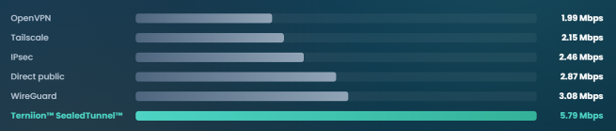
On short-haul U.S. paths, the two land in the same practical band. On the long-haul Singapore route, exactly the kind of intercontinental link where constrained connections usually fall apart, Terniion held 5.79 Mbps while Tailscale dropped to 2.15. Terniion's throughput there is more than double.
TCP connection setup time, milliseconds
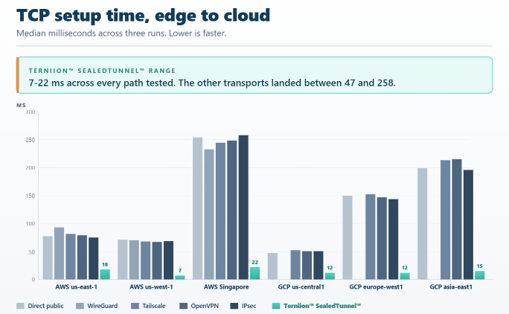
Setup time matters more than it sounds like it should, because it's the tax every short-lived connection pays before it does any work: REST calls, CI/CD jobs, admin dashboards, anything that opens and closes connections all day. Across every region tested, Terniion connected somewhere between four and sixteen times faster than Tailscale. A pipeline making 500 calls spends 25 seconds waiting on Tailscale-style setup times and roughly 4 seconds waiting on Terniion's.
Where Each Platform Fits
Tailscale solved a problem worth solving: getting a distributed team onto a private network without touching firewall rules. For developer teams that want device identity, convenience, and a fast path to "it just works," that's still a legitimate answer.
Where it runs out of room is exactly where the stakes go up: regulated data, critical infrastructure, remote or field sites on unreliable links, and any environment where a single compromised device shouldn't translate into standing network access. That's a structural limit of building around device trust and a shared control plane, rather than process-bound, ephemeral access.
Terniion was built for that second category from the start: no open inbound ports, no long-lived keys to rotate, no coordination server to trust, and access that's scoped to a task instead of a tailnet.
Frequently Asked Questions
FAQs about Tailscale vs. Terniion
Is Terniion a Tailscale replacement, or something you run alongside it? Either. Terniion doesn't require ripping out an existing VPN or mesh network to prove itself. Most teams start it on a single high-value application, run it next to Tailscale, and expand from there once the access model earns its place.
Does moving to process-bound access mean re-architecting how my team works? No. Access is tied to the process definition rather than a manually managed device or user list. When the workload deploys, its access comes with it, and there's no ACL sheet to maintain as people join or leave.
Why does connection setup time matter if my throughput is already fine? Because most traffic runs as hundreds of short connections a day rather than one long file transfer, and a setup-time advantage compounds every time a script, container, or API call opens a new one, which is most of the time.
What happens if a device running Tailscale is lost or stolen? Its keys stay valid on the tailnet until an admin manually revokes that device, a manageable process as long as someone notices quickly. Terniion doesn't have an equivalent step, because there's no long-lived device key sitting on the endpoint to steal in the first place.
Access should end when its purpose does.
Tailscale made private connectivity easier. But for security-conscious organizations, connecting is only the beginning. The harder questions are
What remains trusted
Who controls that trust
How long access survives its original purpose
Terniion makes the task, not the device’s network membership, the boundary of access. Its process-bound model is designed to close the path when the work ends, rather than leave standing access behind for someone to manage.
The constrained-edge results presented here reinforce that architectural case: competitive or higher throughput and consistently faster connection setup. In these tests, tighter access boundaries did not require a performance sacrifice.
For organizations protecting regulated data, critical infrastructure, or distributed operations, the choice should turn on more than deployment convenience. It should turn on the access they are willing to leave in place.
Related content
)
TCP Setup Time is the VPN Metric Nobody's Measuring
VPN setup time benchmark: SealedTunnel™ vs WireGuard, IPsec
Read Blog