Blog
How Xiid's MCP server satisfies SOC 2, ISO 27001, and NIST audit controls
)
Key takeaways
Regulated organizations are deploying AI agents that take real infrastructure actions, but most automation logs live in writable systems so an administrator with sufficient access can alter records without detection.
Xiid's MCP server produces structured, per-line cryptographically signed records of every agent-driven operation, satisfying NIST 800-53 AU-9, FedRAMP High, ISO 27001:2022 (including the newer 5.28 evidence collection control), and SOC 2 logging requirements.
The question auditors now ask specifically—"What did the agent actually do, and how do you know the record is accurate?"—has a structural answer in Xiid's MCP implementation.
Regulated organizations are adopting AI agents faster than their compliance documentation is keeping up. Agents are moving from answering questions to taking actions like:
Configuring infrastructure
Deploying services
Modifying access paths
The audit frameworks that govern those actions haven't changed because a workflow is now automated. They still require that every relevant action be traceable, attributable, and tamper-resistant.
That's where most enterprise automation has a gap. Logs exist, but they live in writable systems. An administrator with sufficient access can modify records without detection, and access controls on log storage are not the same thing as tamper-proof evidence. It's precisely why NIST 800-53 AU-9, FedRAMP High, and ISO 27001:2022 treat protection of audit information as a distinct, enforceable requirement rather than folding it into general logging guidance.
Xiid's MCP server closes this gap structurally. Every agent-driven operation through the MCP surface produces a structured record that is backed by digitally signed, per-line rolling, tamper-evident logs including:
What was requested
Which tool ran
Which Xiid resources were touched
What the result was
Per-line signing means any alteration to a single entry is detectable. The integrity of the full sequence is independently verifiable. Compliance teams get automation they can explain in an audit, not because someone reconstructed it after the fact, but because the evidence was produced at the time of execution.
Specific framework controls satisfied by Xiid MCP evidence
The table below maps Xiid MCP server capabilities to specific controls across major compliance frameworks.
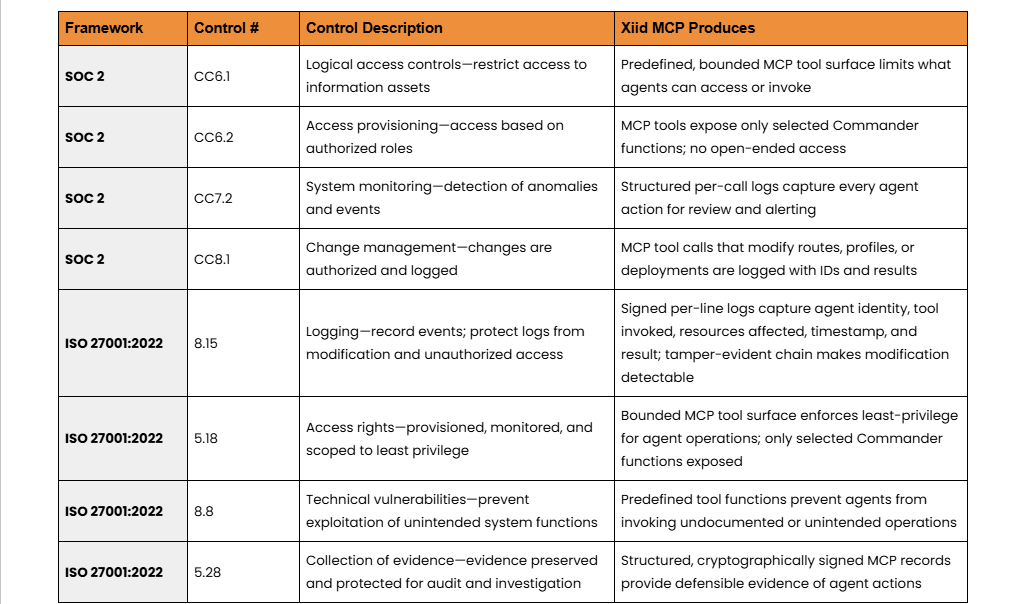
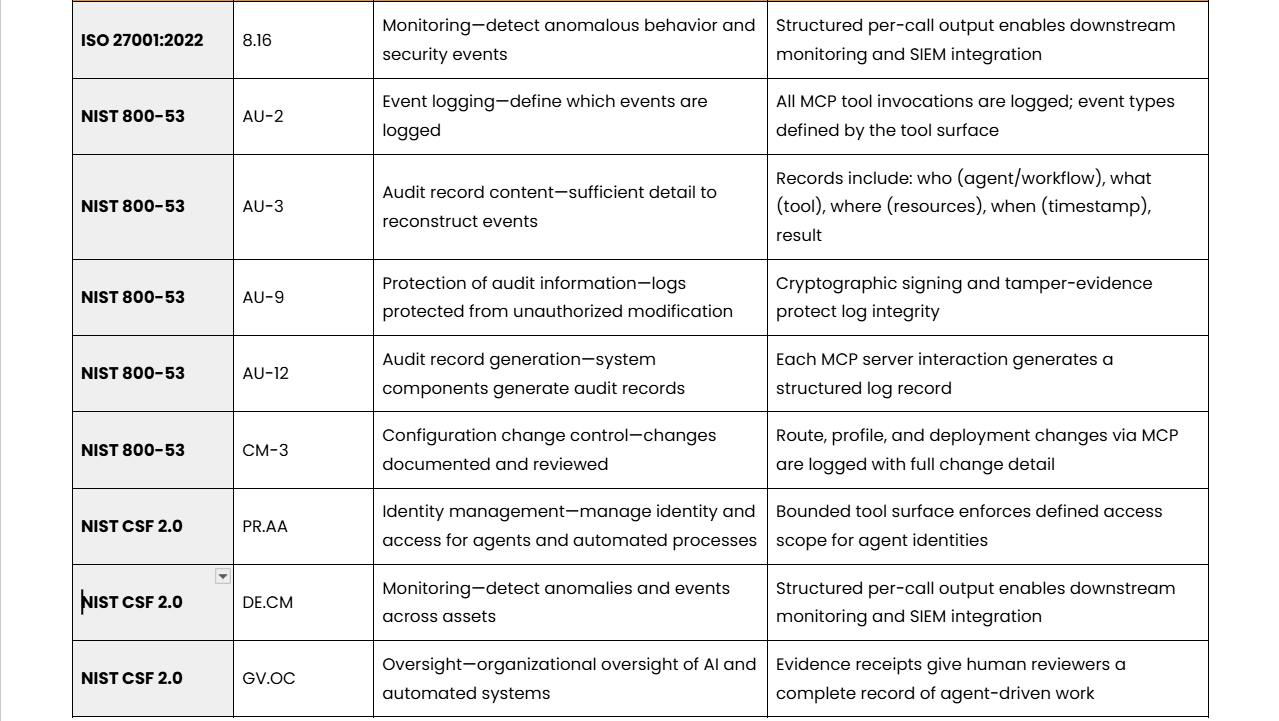
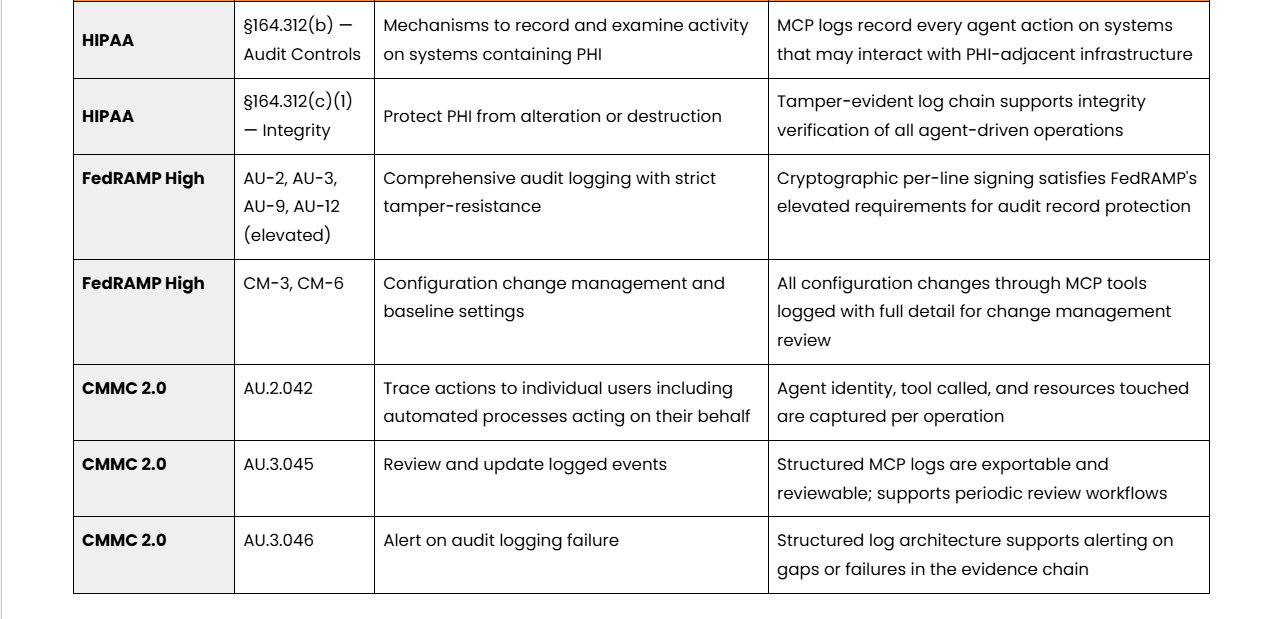
ISO 27001:2022 5.28 deserves specific attention
For organizations currently working through their ISO 27001:2022 gap analysis, 5.28 (Collection of Evidence) is one of the newer controls that many teams are still figuring out how to satisfy. It requires that evidence be preserved, protected, and usable for audit or incident investigation. Xiid's per-line cryptographic signing satisfies both the preservation and the integrity requirements directly, without requiring additional tooling.
For finance, healthcare, federal contractors, and defense supply chain organizations, audit-ready evidence from automated operations is no longer a nice-to-have. Auditors are asking about it specifically. The question is "What did the agent actually do, and how do you know the record is accurate?" now has a structural answer in Xiid's MCP server.
Related content
)
Autonomous Attack Paths: The Security Problem AI Is Creating
As organizations deploy AI agents, autonomous workflows, copilots, and machine-driven orchestration platforms, the actions that matter are no longer primarily human-initiated.
Read Blog